

Publication date:
Joint Statement by European Organisations on the Protection of Unaccompanied Children Displaced from Ukraine
Joint Statement: Responding to Cross-Border Risks & Ensuring International Protection for Unaccompanied and Separated Children from Ukraine in Europe.
Four years into the Russian Federation’s full-scale invasion of Ukraine, the under noted organisations across Europe issue this joint statement to warn of the urgent need to address the needs and risks facing unaccompanied and separated children and young people displaced from Ukraine as the EU considers the future of temporary protection and longer-term pathways for people displaced from Ukraine. What began as an emergency response has become a protracted, structurally fragile situation in which children and young people’s safety, development, and future prospects are increasingly shaped by fragmented systems rather than coherent protection frameworks.
What is at stake for children and young people?
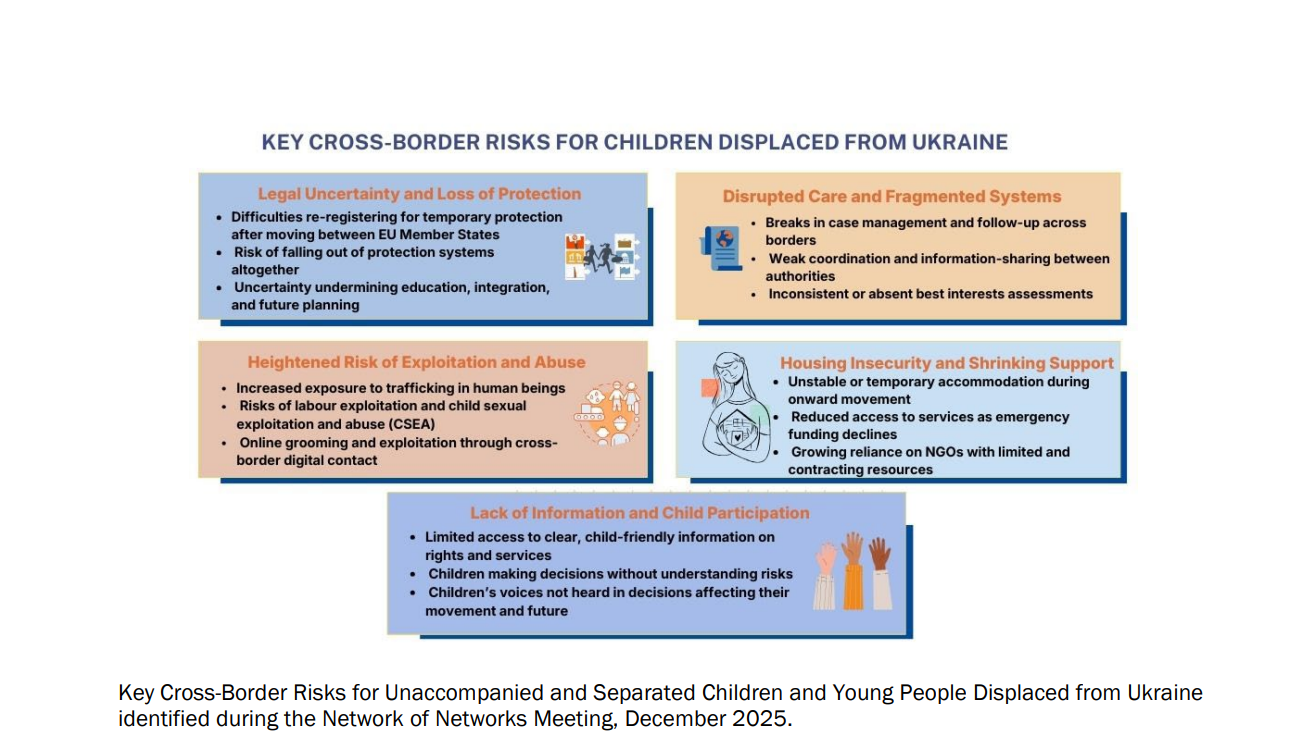
Discussions between networks at a meeting held in Brussels in December last year identified crossborder movement as a compounder of risks for unaccompanied and separated children and young people displaced from Ukraine. As they move between EU Member States and in and out of Ukraine in search of education, work, family reunification, or stability, they may fall off the radar of national child protection systems and become exposed to risks of going missing, exploitation and trafficking, simultaneously disrupting education, employment pathways, continuity of care and access to services and support.
These risks do not occur in isolation: they are amplified by a lack of reliable information for children,
legal uncertainty around future status and registration during onward movement, weak information
sharing between national child protection systems and a lack of risk assessments.
The gradual winding down of humanitarian funding and absent or fragmented cross-border coordination mechanisms has direct consequences for children’s daily lives. Individual best interests assessments are delayed or absent; continuity of care across borders is fragile; and long-term planning for education, housing, and legal status is increasingly out of reach.
While this statement focuses on unaccompanied and separated children and young people displaced from Ukraine, many of the risks described reflect broader and long-standing protection gaps affecting unaccompanied and separated children across Europe, irrespective of country of origin. Fragmented guardianship systems, uneven access to legal support, and limited cross-border case cooperation continue to leave many children exposed to harm. Addressing these systemic weaknesses is essential not only to protect children from Ukraine, but also to strengthen Europe’s overall child protection architecture in cross-border contexts.
How do children and young people feel?
Young people themselves describe lives shaped by uncertainty. The voices of young people displaced
from Ukraine, heard through Missing Children Europe’s You Decide youth participation initiative,
highlight difficulties re-registering for protection after moving countries, fear of losing legal status
when turning 18, and reliance on shrinking NGO support simply to secure housing or continue
studies.
“You study, you learn the language, you try to integrate… but you don’t know if you will be
allowed to stay. Life feels temporary.” — Member of the YoU Decide Youth Board.
For many, the transition to adulthood coincides with an abrupt loss of guardianship, accommodation,
and legal assistance. As the end of temporary protection approaches, these systemic gaps risk hardening into long-term exclusion. Without clarity at the EU level, children and young people displaced from Ukraine who have spent their formative years in Europe face interrupted education, stalled integration, and heightened susceptibility to exploitation. Fragmented legal frameworks and limited cross-border coordination translate directly into lived vulnerabilities: confusion about rights, reliance on informal information channels, and declining trust in protection systems designed to safeguard them.
This moment represents a critical juncture requiring strengthened implementation of existing EU and
international child protection obligations, including best interests procedures, guardianship, and cross-border case cooperation. Child protection in cross-border contexts cannot be left to ad hoc national responses. Sustained EU leadership, coordination, and funding are required to prevent foreseeable harm and uphold children’s rights.
Recommendations for the European Union, Member States, and Civil Society
- Provide national and regional clarity on post-temporary protection residency pathways for
unaccompanied and separated children and youth displaced from Ukraine as well as their
caregivers, ensuring continuity and stability of residence status where needed and access to
services across borders. - Support projects developing minimum standards for cross-border case cooperation, including
shared referral pathways, best interests assessments, data protection and child-safe data- and
information-sharing mechanisms across Member States and Ukraine and across national
authorities and civil society organisations, including networks of organisations working with
children. - Invest in guardianship, free legal assistance, and specific safeguards for children transitioning
into adulthood, including third country nationals, to prevent statelessness and abrupt loss of
support when a youth turns 18. - Make resources available for prevention and response mechanisms for missing children, child
trafficking, and exploitation, including strengthened child helplines and hotlines, particularly
when considering voluntary, safe, and dignified returns to Ukraine. - Strengthen knowledge-sharing and awareness-raising on cross-border risks for children
displaced from Ukraine, by supporting training, thematic exchanges, and communication
campaigns for professionals, networks, and communities working with children. - Support child- and youth-centered information and participation initiatives at EU level, codesigned with displaced children from Ukraine, to ensure access to accurate, rights-based
guidance during cross-border movement and status transitions. - Ensure victim-centred, trauma-informed, child-sensitive and intersectional approaches across all
protection, asylum, migration and justice procedures affecting displaced children from Ukraine,
including early identification of victims, access to generic and specialised support and
safeguards against secondary victimisation. - Guarantee victim-sensitive, child-friendly access to safe justice for unaccompanied and
separated children experiencing violence, abuse or exploitation across Member States, and
strengthen integrated child protection systems to ensure cross-border continuity of care, support
and protection.
Without decisive EU action and sustained investment, the risks facing unaccompanied and separated children displaced from Ukraine will intensify. With it, Europe can prevent avoidable harm and secure children and young people’s safety, development, and futures.
Signatories
- Victim Support Europe (VSE)
- Kids in Need of Defense (KIND)
- Missing Children Europe (MCE)
- Association for Integration and Migration (SIMI)
- Asylkoordination Österreich
- Caritas Europa
- Child Friendly Justice – European Network (CFJ-EN)
- Child Circle
- ChildFund Alliance
- Child Helpline International
- Consiglio Italiano per i Rifugiati – Italian Refugee Council (IRC)
- COFACE Families Europe
- eLiberare
- European Lawyers in Lesvos (ELIL)
- European Network on Statelessness (ENS)
- Edustajat Turvapaikanhakijalapsille – Національна асоціація, що підтримує опікунів дітей без супроводу у Фінляндії (ETU)
- Eurochild
- Fundacja Dajemy Dzieciom Siłę (FDDS)
- Hope and Homes for Children
- Immigrant Council of Ireland (ICI)
- International Coalition of Sites of Conscience (ICSC)
- International Falcon Movement – Socialist Educational International
- Institute for International Criminal Investigations
- La Strada International
- Make Mothers Matter
- Platform for International Cooperation on Undocumented Migrants (PICUM)
- Plan International
- Polskie Forum Migracyjne (PFM)
- Right 2 Protection
- Save the Children Europe
- Sempre a Frente
- Slovenska Filantropija
- Terre des Hommes International
- Ukrainian Child Rights Network (UCRN)
- Ukraine Civil Society Forum (UCSF)
- United Nations High Commissioner for Refugees (UNHCR)